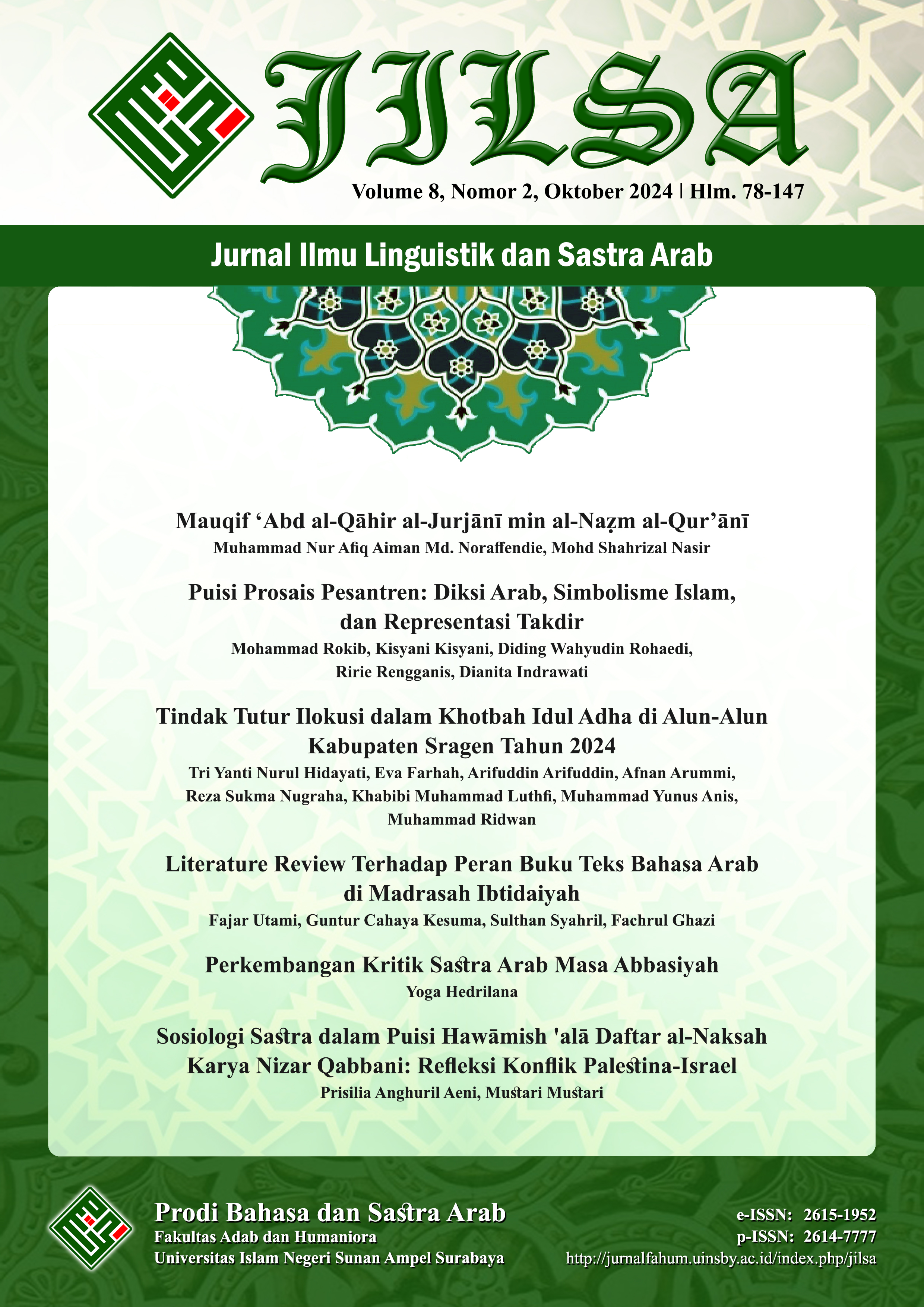
Puisi Prosais Pesantren: Diksi Arab, Simbolisme Islam, dan Representasi Takdir
DOI:
https://doi.org/10.15642/jilsa.2024.8.2.89-100Keywords:
puisi prosais, sastra, representasi, Islam, pesantrenAbstract
This study examines prosaic poetry of pesantren, focusing on the use of Arabic diction, Islamic symbolism, and the concepts of destiny and divine will in Islamic-sense poetry or literature. The research aims to understand how these elements shape aesthetics and meaning in prosaic poetry written by teachers at Madrasah Bertaraf Internasional (MBI) Pesantren Amanatul Ummah. Using a qualitative approach, the study analyzes a collection of prosaic poetry produced during a creative writing workshop. The findings reveal that Arabic diction functions not only as a linguistic element but also as an Islamic identity marker. Islamic symbolism in poetry reflects writers’ religious experiences, while the concepts of destiny and divine will highlight spiritual reflections in their works. This study contributes to contemporary Islamic literary studies and offers new perspectives on the relationship between literature, language, and religious values within the pesantren educational context.
Downloads
References
Abdul Hadi, W. M. (2001). Tasawuf yang Tertindas: Kajian Hermeneutik terhadap Karya-Karya Sastra Sufi. Jakarta: Paramadina.
Abrams, M. A Glossary of Literary Terms. Boston: Wadsworth Cengage Learning, 2012.
Al-Jurjani, A. (1959). Asrar al-Balaghah. Cairo: Dar al-Ma'arif.
Chaer, A. (2009). Linguistik Umum. Jakarta: Rineka Cipta.
Chaer, A. (2012). Kajian Bahasa. Jakarta: Rineka Cipta.
Creswell, John W. Research Design: Qualitative, Quantitative, and Mixed Methods Approaches. Los Angeles: SAGE Publications, 2014.
Culler, J. (2000). Literary Theory: A Very Short Introduction. Oxford: Oxford University Press.
Endraswara, Suwardi. Metodologi Penelitian Sastra: Epistemologi, Model, Teori, dan Aplikasi. Yogyakarta: Caps, 2011.
Fowler, A. (1987). A History of Literary Genres. Cambridge: Harvard University Press.
Hardjana, A. (1991). Kritik Sastra: Sebuah Pengantar. Jakarta: Gramedia Pustaka Utama.
Iser, Wolfgang. The Act of Reading: A Theory of Aesthetic Response. Baltimore: Johns Hopkins University Press, 1978.
Keraf, G. (2001). Diksi dan Gaya Bahasa. Jakarta: Gramedia Pustaka Utama.
Keraf, G. (2004). Komposisi: Sebuah Pengantar Kemahiran Bahasa. Jakarta: Gramedia Pustaka Utama.
Kristeva, J. (1980). Desire in Language: A Semiotic Approach to Literature and Art. New York: Columbia University Press.
Moleong, Lexy J. Metodologi Penelitian Kualitatif. Bandung: PT Remaja Rosdakarya, 2019.
Pradopo, R. D. (2005). Beberapa Teori Sastra, Metode Kritik, dan Penerapannya. Yogyakarta: Pustaka Pelajar.
Pradopo, R. D. (2010). Pengkajian Puisi: Analisis dan Pembelajaran. Yogyakarta: Gadjah Mada University Press.
Stake, Robert E. Qualitative Research: Studying How Things Work. New York: Guilford Press, 2010.
Sudjiman, P. (1992). Kamus Istilah Sastra. Jakarta: Gramedia Pustaka Utama.
Teeuw, A. (1984). Sastra dan Ilmu Sastra: Pengantar Teori Sastra. Jakarta: Pustaka Jaya.
Wellek, R., & Warren, A. (1963). Theory of Literature. New York: Harcourt, Brace & World.
Downloads
Published
How to Cite
Issue
Section
License
Copyright (c) 2024 Mohammad Rokib, Kisyani Kisyani, Diding Wahyudin Rohaedi, Ririe Rengganis, Dianita Indrawati (Author)

This work is licensed under a Creative Commons Attribution-ShareAlike 4.0 International License.