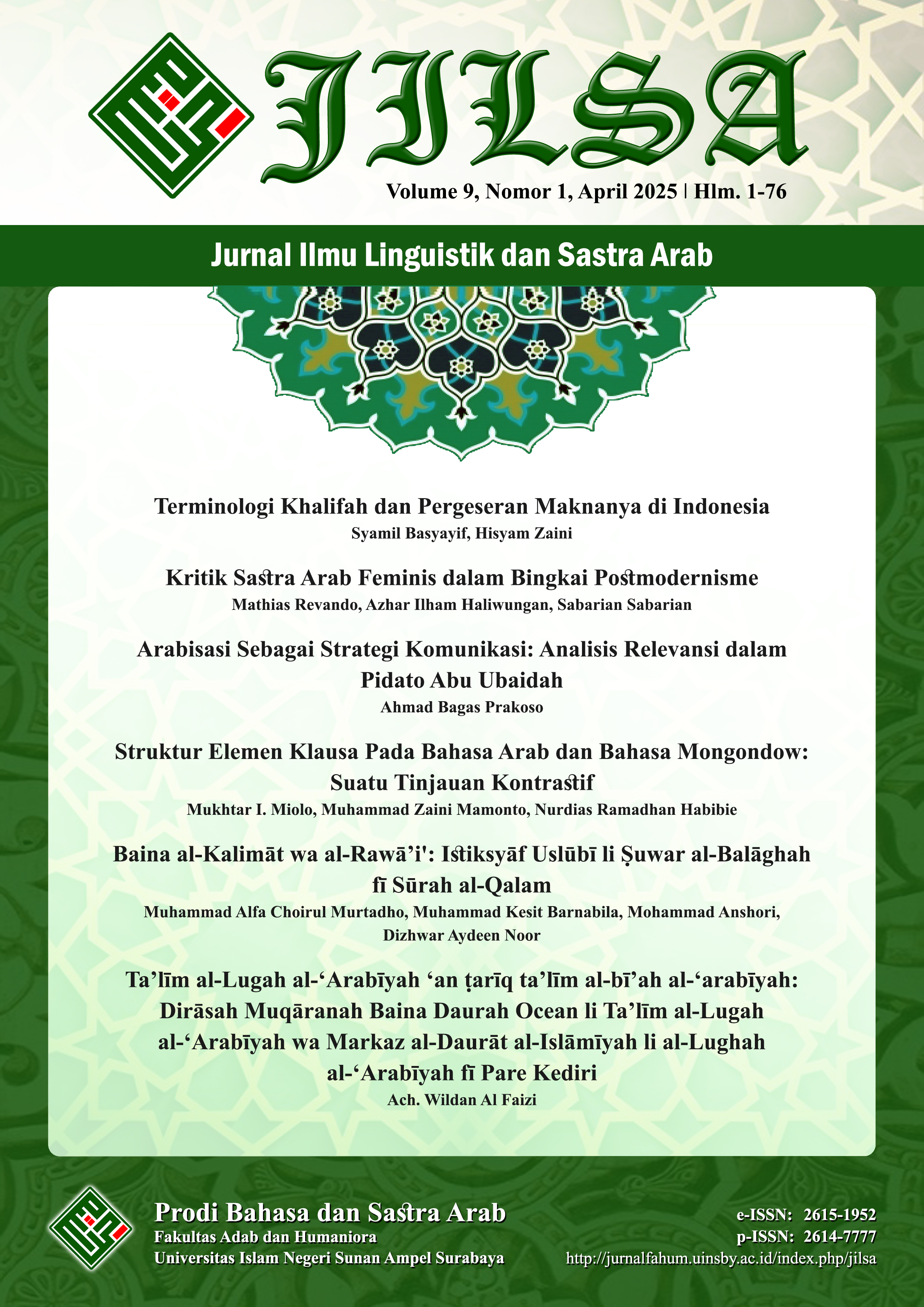
Kritik Sastra Arab Feminis dalam Bingkai Postmodernisme
DOI:
https://doi.org/10.15642/jilsa.2025.9.1.11-22Keywords:
Feminism, Postmodernism, Literary criticismAbstract
Human thought continues to evolve over time, undergoing various changes. This is inseparable from the human desire to always adapt and change as the problems and needs faced increase. The emergence of Postmodernism was triggered by the existence of modernism. Modernism gives the impression of progress, luxury, and rapid progress. Modernism promises to create change towards a more stable world, where all human needs can be met. Rationality was seen as a tool to overcome myths and traditional beliefs that were considered unfounded, which had been considered to make humans weak in facing the realities of the world. Feminist criticism offers a proposal to study literature as a manifestation of the forms of power in society that we inherit, which must be changed if change is desired. This research uses a qualitative or naturalistic inquiry approach. In naturalistic inquiry, researchers are not required to form certain conceptions or theories in advance related to the field under study. Instead, researchers can approach the field of research with an open mind and let their opinions emerge and be motivated by the facts that occur naturally in the field. Feminist literary criticism plays a very important role in analyzing Arabic literary works in the postmodern era. This is due to the fact that many contemporary Arabic literary works still tend to portray women in sexist ways, based on rigid stereotypes, marginalized from central roles, and do not even treat them as full human beings. When associated with gender issues, this approach will reveal patterns of gender relations that are not only hierarchical, but also offer other meanings that are more plural, humanist and egalitarian. The feminist figures of Arab such as Qasim Amin, Nāwal As-Sa'dāwī and Fatima Mernissi became symbols of resistance from Arab lands.
Downloads
References
Fedwa Malti Douglas. Woman’s Body, Woman’s Word: Gender and Discourse in Arabo-Islamic Writing. New jersey: PRINCETON UNIVERSITY PRESS PRINCETO, 2019.
Kalean. Filsafat Bahasa: Masalah dan Perkembangannya. Yogyakarta: Paradigma, 1998.
Latifi, Yulia Nasrul. “Kajian Kesusastraan Arab di Era Postmodernisme.” Jurnal Penelitian Agama XVII, no. 3 (2008): 607–30.
———. “REKONSTRUKSI PEMIKIRAN GENDER DAN ISLAM DALAM SASTRA: Analisis Kritik Sastra Feminis Terhadap Novel Zaynah Karya Nawal As-Sa’dawi.” Musãwa Jurnal Studi Gender dan Islam 15, no. 2 (2016): 249. https://doi.org/10.14421/musawa.v15i2.1308.
Latifi, Yulia Nasrul, dan Wening Udasmoro. “The Big Other Gender, PAtriarki, dan Wacana Agama dalam Karya Sastra Nawāl Al-Sa’dāwī.” Musãwa Jurnal Studi Gender dan Islam 19, no. 1 (28 September 2020): 1–20. https://doi.org/10.14421/musawa.2020.191.1-20.
Maksum Ali. Pengantar Filsafat : Dari Masa Klasik Hingga Postmodernisme. Yogyakarta: Ar-Ruzz Media, 2016.
Moleong, dan J Lexy. Metodologi Penelitian Kualitatif. Bandung, 2017.
Muqsith Abdul. Merayakan Kebebasan Beragama: Bunga Rampai 70 Tahun Djohan Efendi. Merayakan Kebebasan Beragama: Bunga Rampai 70 Tahun Djohan Effendi. Jakarta: Kompas, 2011.
Nasution Harun. Pembaharuan dalam Islam: Sejarah, Pemikiran dan Gerakan. Jakarta: Bulan Bintang, n.d.
Politics, Textual, dan Toril Moi. Sexual/Textual Politics: Feminist Literary Theory. Methuen: London and New York, 1994.
Ramzi Saiti. “Paradise, Heaven, and Other Oppressive Spaces: ACritical Examination of The Life and Works of Nawal el-Saadawi.” Journal of Arabic Literature 3, no. 3 (1994): 187–262. https://www.jstor.org/stable/257635?origin=crossref.
Setiawan, Johan, dan Ajat Sudrajat. “Pemikiran Postmodernisme Dan Pandangannya Terhadap Ilmu Pengetahuan.” Jurnal Filsafat 28, no. 1 (2018): 25. https://doi.org/10.22146/jf.33296.
Showalter Elaine. The New Feminst Critism. Washington, DC, 1985.
Suparno. “Perempuan dalam Pandangan Feminis Muslim.” Jurnal Fikroh 8, no. 2 (2015): 1–19.
Wiyatmi. Kritik Sastra Feminis Teori dan Aplikasinya dalam Sastra Indonesia. Yogyakarta: Penerbit Ombak, 2012. https://www-thoughtco-com.translate.goog/feminist-literary-criticism-3528960?_x_tr_sl=en&_x_tr_tl=id&_x_tr_hl=id&_x_tr_pto=wapp.
Yaqin, Moh. Ainul. “Puisi Ayyuhā al-Nās Karya Tamim al-Barghouti: Analisis Semiotika Riffaterre.” JILSA (Jurnal Ilmu Linguistik dan Sastra Arab) 6, no. 1 (2022): 22–35. https://doi.org/10.15642/jilsa.2022.6.1.22-35.
Downloads
Published
How to Cite
Issue
Section
License
Copyright (c) 2025 Mathias Revando, Azhar Ilham Haliwungan, Sabarian Sabarian (Author)

This work is licensed under a Creative Commons Attribution-ShareAlike 4.0 International License.